
We hold these truths to be self-evident, that all men are created equal, that they are endowed by their Creator with certain unalienable Rights, that among these are Life, Liberty and the pursuit of Happiness. That to secure these rights, Governments are instituted among Men, deriving their just powers from the consent of the governed. That whenever any Form of Government becomes destructive of these ends, it is the Right of the People to alter or to abolish it, and to institute new Government, laying its foundation on such principles and organizing its powers in such form, as to them shall seem most likely to effect their Safety and Happiness.
–U.S. Declaration of Independence, July 4, 1776
Introduction
The Declaration of Independence asserted to “governments are instituted” to secure the “unalienable rights of life, liberty and happiness.”
As Americans celebrate the 250th anniversary of the Declaration, Penn State’s McCourtney Institute for Democracy wanted to learn how Americans think our system of governance is delivering on this promise. We find that most Americans feel that governments are coming up short across the board, but especially so when it comes to the pursuit of happiness.
These results come from a McCourtney Institute Mood of the Nation poll conducted May 19 to 26, 2026, by YouGov. The poll has a margin of error of ± 3.8% for the full sample of 1,000 adults.
Because the U.S. has a system of shared governance, we specifically asked respondents to consider “America’s system of government – the combined work of the federal, state, and local governments.” In that way, citizens might conclude that their safety and security needs are being met, even if they find fault with one level of government.
We asked respondents to evaluate seven different kinds of government performance on a four-point scale ranging from “excellent” to “poor.” Respondents could also tell us that they felt that it was not a governmental responsibility. We then translated the ratings to letter grades and grade point averages using a traditional scale:
Excellent A 4 points
Good B 3 points
Fair C 2 points
Poor D 1 point
When we average grades across all seven government responsibilities, Americans give the system of government a C+ overall.
We also asked them to explain some of their answers, which provides additional context.
Life
By and large, Americans feel that our system of federal, state and local governments are doing an OK job in keeping people safe from outside threats. Seventeen percent rated government performance excellent and another 36% said good. This equates to a grade point average of 2.5, at the borderline of C+ and B-.
Americans gave the system of government poorer marks in protecting lives from crime (GPA of 2.0) and from non-crime dangers such as fires and floods (GPA of 2.1).
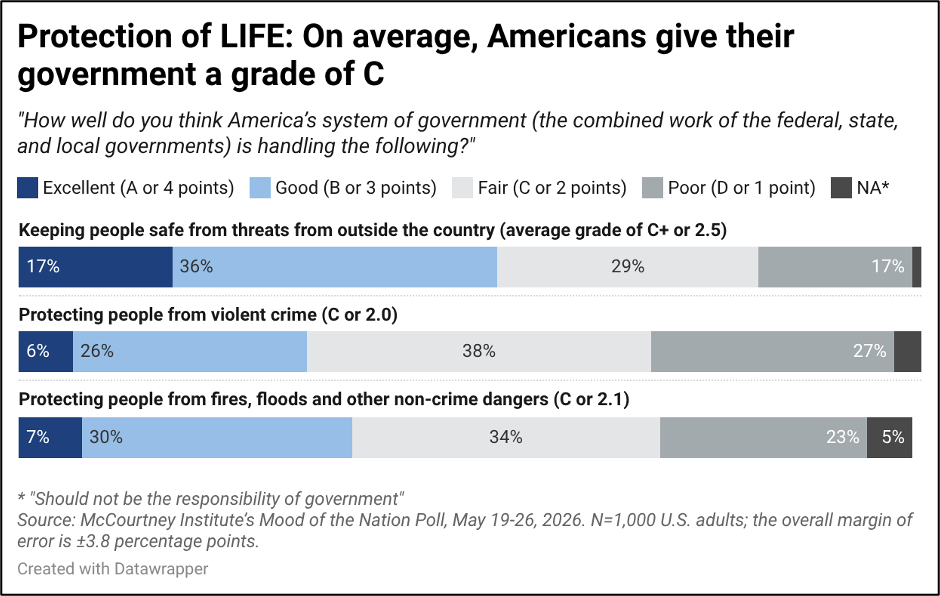
Five percent of American adults feel that it is not government’s responsibility to protect people from non-crime dangers, compared to only 3% who said the same regarding violent crime and 1% regarding threats originating outside of the U.S.
Liberty
We posed two questions about liberty, and the results were very similar. Only 14% said that our system of government was doing an excellent job “Ensuring that citizens can express their views, even when they are unpopular” and 17% gave a grade of excellent for “Ensuring that citizens can worship, think, and travel as they please.”
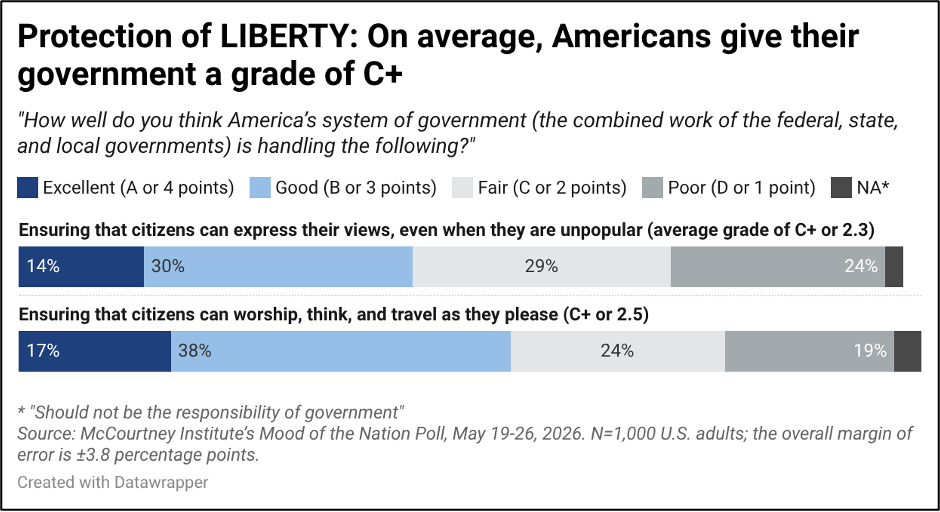
Compared the items in the Life and Pursuit of Happiness categories, Americans gave slightly higher ratings to the government’s performance related Liberty, averaging C+ as opposed to C.
Pursuit of Happiness
For the third unalienable right we asked how well our system of government was “Ensuring that citizens have the opportunity to live a satisfying and happy life.” We also asked a more specific question about the opportunity for economic opportunity for those who work hard.
In both instances, Americans gave a grade of C (GPAs of 2.0 and 1.9, respectively).
These two items were asked in two ways: Half the sample were randomly assigned to a question about the opportunities for “citizens” and the other half were asked about “young people.” We thought Americans might be more critical of the opportunities afforded young people. However, the results are statistically indistinguishable. Tests of independence cannot reject the null for economic opportunity (p = 0.81), or for satisfying life (p = 0.22). For this reason, we combine results from both versions of the questions.
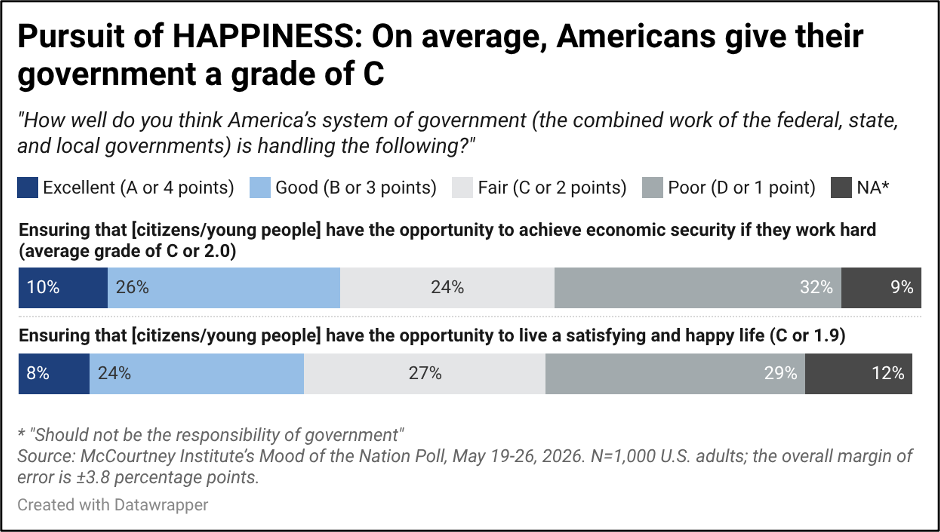
Notably, while “happiness” is mentioned twice in the Declaration of Independence, a higher proportion of Americans indicated that our two proxies for happiness “should not be the responsibility of government” than was the case for the items which served as proxies for life and liberty.
Overall grade: C+
The overall average rating given by American adults to the 7 items in our survey representing the government’s handling of the unalienable rights outlined in the Declaration of Independence equates to a grade point average of 2.3, the equivalent of a C plus.
Almost every demographic group views performance as mediocre: The GPA according to men is 2.4, only slightly higher than the 2.2 GPA among women. Those earning over $100,000 a year give our system of government a GPA of 2.4 and those earning less than $30,000 give it a similar GPA of 2.3. Grades do not differ appreciably in the eyes of White, Black or Hispanic Americans, or from the perspective of young or old, or by educational attainment.
Evaluations only differ appreciably by political allegiance. Those who voted for Donald Trump in the 2024 presidential election give our system of government a 2.7 – a firm B minus. Those who voted for Kamala Harris give an average rating of 1.9 or a lower C.
Similarly, the 20% of Americans who think that President Trump is doing a “great” job also give the government a relatively high 3.0 grade point average, compared to the relatively low 1.9 GPA resulting from the responses of those who think Trump is doing a poor job
Fifty percent of Americans think President Trump is doing a poor job. For more detail on this poll’s findings regarding job approval ratings for the president, congress and the Supreme Court, see https://democracy.psu.edu/poll-report-archive/fewer-than-four-in-ten-americans-think-president-trump-is-doing-a-good-job/

In their own words: Pursuit of Happiness
Respondents were asked to explain their responses to one of the two statements regarding pursuit of happiness: half were randomly assigned to explain their rating of the statement about providing opportunities to ensure economic security, with the other half were asked to explain their rating of the statement regarding the opportunity to live a satisfying and happy life.
In either case, the original statement was presented to them, including whether it referenced opportunities for “citizens” or “young people,” along with their response.
- If people gave an answer of Excellent or Good, their probe was “Can you tell us what you think America’s system of government is doing well to provide opportunities?”
- If people gave an answer of Fair or Poor, their probe was “Can you tell us what you think America’s system of government could be doing better to provide opportunities in the future?
Regardless of whether people were responding to their high rating of the government’s performance related to economic security or the opportunity to live a satisfying and happy life, the words that came up most often related to jobs and education.
Those responding to the statement regarding economic opportunities were also likely to mention business and entrepreneurship. Many of those responding to the statement regarding happiness also frequently mentioned freedom, choice and life.
There appears to be some difference in responses along political lines. Democrats most frequently mention education. Many Republicans mention education, but many also mention entrepreneurship and ideas related to getting government out of the way. Some Republicans also offered politicized answers that refer to “illegals” and “handouts.”
Examples of the responses to the question “Can you tell us what you think America’s system of government is doing well to provide opportunities?” include:
Excellent or Good rating of the statement, “How well do you think America’s system of government is handling… Ensuring that [citizens/young people] have the opportunity to achieve economic security if they work hard?”
“People have so many more opportunities to better themselves and their children than anywhere else in the world” – 57-year-old White male Republican from Georgia.
“The government [is] doing lots for their citizens by protecting individual property rights, investing in human capital” – 40-year-old Black female Republican from Texas.
“It’s not perfect, but people can have a decent living if they work hard enough.” – 44-year-old White female Democrat from Florida.
“Access to education.” – 58-year-old Hispanic female Democrat from South Carolina.
Excellent or Good rating of the statement, “How well do you think America’s system of government is handling… Ensuring that [citizens/young people] have the opportunity to live a satisfying and happy life?”
“New job opportunities, good schooling systems and healthcare.” – 30-year-old White female Democrat from New York.
“Supplying jobs, opportunities, and education.” – 44-year-old Black female Democrat from Nebraska.
“Public education, employment opportunities and training and providing an environment where people can run their own businesses and support themselves.” – 62-year-old White female Republican from West Virginia
“I believe America’s system encourages entrepreneurship, protects free speech, and creates opportunities for education, jobs, and personal growth.” –25-year-old Black male Republican from Kentucky.
Among those saying fair or poor: What the government could be doing better
Words that were most frequently mentioned by those asked what the government could be doing better include “more,” “education,” “healthcare” and “better.” “Jobs” were also frequently mentioned by those responding to the statement about economic security, and both “housing” and “affordable” were common words mentioned by those responding to the statement concerning a satisfying and happy life.
Once again answers appeared to differ along political lines. Democrats often mentioned unmet needs for education, healthcare, childcare and housing. Many Republican respondents pointed to taxes being too high, and some indicated that government pays more attention to powerful corporations than to smaller businesses.
Examples of the responses to the question “Can you tell us what you think America’s system of government could be doing better to provide opportunities in the future?” include:
Fair or Poor rating of the statement, “How well do you think America’s system of government is handling… Ensuring that [citizens/young people] have the opportunity to achieve economic security if they work hard?”
“Make healthcare, education, and housing more affordable, while also improving wages and job training, so people who work hard can realistically keep up with the cost of living and build financial stability.” – 42-year-old Hispanic female independent from California.
“I think the government should back out and let the system do its thing.” – 50-year-old White female Republican from Oklahoma.
“Lowering living costs and making it more affordable to rent and buy housing.” – 24-year-old White male Democrat from New York.
“Too many young people are boggled down with a lot of student loans trying to get a better education. I think community college should be free to everybody.” – 60-year-old Hispanic female Democrat from Massachusetts.
Fair or Poor rating of the statement, “How well do you think America’s system of government is handling… Ensuring that [citizens/young people] have the opportunity to live a satisfying and happy life?”
“America’s system needs to do a better job at making it easier to join the workforce. The unemployment in the country does not allow the opportunity for a satisfying and happy life.” – 21-year-old Hispanic male Democrat from Georgia.
“Equality levels have gone down. We need to coexist with our fellow Americans. Not everyone is the same (i.e. religious beliefs, sexual orientations).” – 57-year-old White female Democrat from California.
“Lowering the cost of living especially housing healthcare and education” – 26-year-old White male Republican from Texas.
“Both parties are focused on themselves and don’t care about things that matter to us like ensuring social security will be around, reducing inflation so people can afford houses and stop taxing us for everything making it harder to survive financially.” – 56-year-old Hispanic male Republican from Colorado.
Appendix: Word Clouds


About the survey
Survey transparency disclosures
Data collection for this Mood of the Nation Poll was conducted online by YouGov (https://today.yougov.com/). The YouGov panel includes over 1.8 million individuals who agree to complete occasional surveys.
Most Mood of the Nation Polls, are cross-sectional polls of approximately 1,000 U.S. adults, matched to a sampling frame on gender, age, race, and education. The frame was constructed by stratified sampling from the full 2023 American Community Survey (ACS) 1-year sample with selection within strata by weighted sampling with replacements (using the person weights on the public use file).
The data are then post-stratified on 2024 presidential vote choice as well as a four-way stratification of gender, age (4-categories), race (4-categories), and education (4-categories), to produce the final weight.
About the McCourtney Institute for Democracy
The McCourtney Institute for Democracy at Penn State promotes scholarship and practical innovations that defend and advance democracy in the United States and abroad. Through teaching, research and public outreach, the Institute leverages the resources of Penn State and partners around the world to foster a model of deliberation, policymaking and responsiveness that is passionate, informed and civil.
The Mood of the Nation Poll offers a unique approach to public opinion polling. It allows Americans to speak in their own words through open-ended questions that focus on emotions like anger and hope, as well as commitment to constitutional principles.
Acknowledgments
This report was authored by Eric Plutzer, Ph.D., of Penn State’s McCourtney Institute for Democracy, who also designed the survey questions in his role as Director of the Mood of the Nation Poll, and Craig Helmstetter, Ph.D.